

This is the Multiple Choice Questions in Basic Op-Amp Circuits from the book Electronic Devices – Electron Flow Version and Conventional Current Version 8th Edition by Thomas L. Floyd. If you are looking for a reviewer in Electronics Engineering this will definitely help. I can assure you that this will be a great help in reviewing the book in preparation for your Board Exam. Make sure to familiarize each and every questions to increase the chance of passing the ECE Board Exam.
If you are looking for the Self-test in Floyd’s Electronic Devices proceed to
Practice Exam Test Questions
Choose the letter of the best answer in each questions.
1. If an op-amp comparator has a gain of 100,000, an input difference of 0.2 mV above reference, and a supply of ±12 V, the output will be
A. 20 V.
B. 12 V.
C. 10 V.
D. 15 V.
Answer: Option B
Solution:
2. To reduce the effects of noise resulting in erratic switching of output states of a comparator, you can use
A. the upper trigger point.
B. the lower trigger point.
C. nonzero-level detection.
D. hysteresis.
Answer: Option D
Solution:
3. A comparator with a Schmitt trigger has
A. two trigger levels.
B. a fast response.
C. a slow response.
D. one trigger level.
Answer: Option A
Solution:
4. In a comparator with output bounding, what type of diode is used in the feedback loop?
A. Schottky
B. junction
C. zener
D. varactor
Answer: Option C
Solution:
5. In a flash A/D converter, the priority encoder is used to
A. select the first input.
B. select the highest value input.
C. select the lowest value input.
D. select the last input.
Answer: Option B
Solution:
6. A differentiator is used to measure
A. the sum of the input voltages.
B. the difference between two voltages.
C. the area under a curve.
D. the rate of change of the input voltage.
Answer: Option D
Solution:
7. An op-amp has an open-loop gain of 90,000. Vsat = ±13 V. A differential voltage of 0.1 V p-p is applied between the inputs. What is the output voltage?
A. 13 V
B. –13 V
C. 13 Vp-p
D. 26 Vp-p
Answer: Option D
Solution:
8. Refer to Figure 13-1(a). Determine the output voltage.
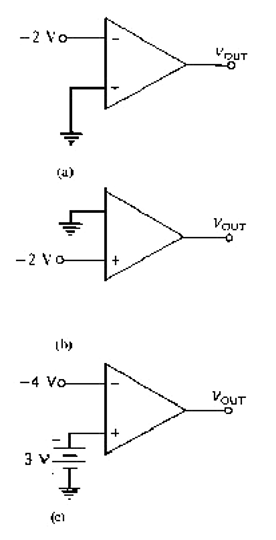
Figure 13-1
A. 1 V
B. –1 V
C. +Vsat
D. –Vsat
Answer: Option C
Solution:
9. Refer to Figure 13-1(b). What is the output voltage?
A. 2 V
B. –2 V
C. +Vsat
D. –Vsat
Answer: Option D
Solution:
10. Refer to Figure 13-1(c). With the inputs shown, determine the output voltage.
A. 7 V
B. –7 V
C. +Vsat
D. –Vsat
Answer: Option C
Solution:
11. Refer to Figure 13-2(a). What is the output voltage?
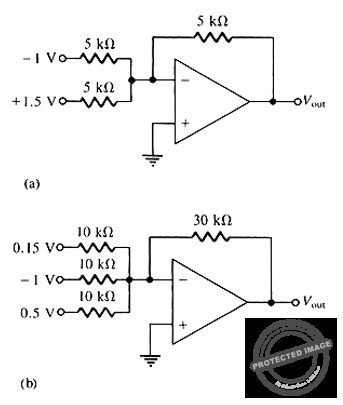
Figure 13-2
A. 0.5 V
B. –0.5 V
C. 2 V
D. –2 V
Answer: Option B
Solution:
12. Refer to Figure 13-2(b). Determine the output voltage, VOUT.
A. 1.05 V
B. –0.35 V
C. 0.35 V
D. –1.05 V
Answer: Option A
Solution:
13. Refer to Figure 13-3(a). Determine the upper trigger point.
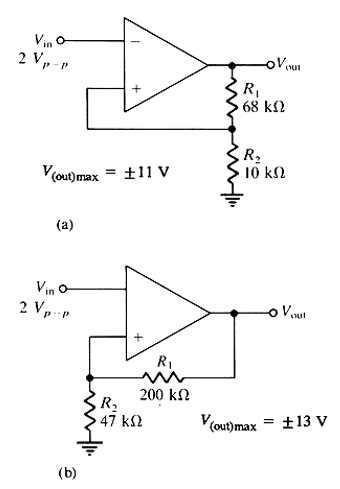
Figure 13-3
A. V(out)max
B. –V(out)max
C. –1.41 V
D. +1.41 V
Answer: Option D
Solution:
14. Refer to Figure 13-3(b). Determine the lower trigger point.
A. +V(out)max
B. –V(out)max
C. –2.47 V
D. +2.47 V
Answer: Option C
Solution:
15. Refer to Figure 13-4(a). This circuit is known as
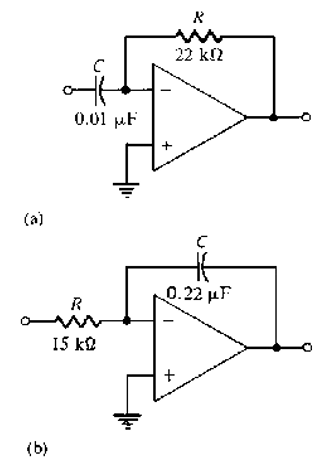
Figure 13-4
A. a noninverting amplifier.
B. a differentiator.
C. an integrator.
D. a summing amplifier.
Answer: Option B
Solution:
16. Refer to Figure 13-4(b). This circuit is known as
A. a noninverting amplifier.
B. a differentiator.
C. an integrator.
D. a summing amplifier.
Answer: Option C
Solution:
17. Refer to Figure 13-4(b). A square-wave input is applied to this amplifier. The output voltage is most likely to be
A. a square wave.
B. a triangle wave.
C. a sine wave.
D. no output.
Answer: Option B
Solution:
18. Refer to Figure 13-4(b). If Vin = 5 V, the rate of change of the output voltage in response to a single pulse input is:
A. 15.2 mV/µs
B. 1.52 V/µs
C. 1.52 mV/µs
D. 15.2 V/µs
Answer: Option C
Solution:
19. The output of a Schmitt trigger is a
A. pulse waveform.
B. sawtooth waveform.
C. sinusoidal waveform.
D. triangle waveform.
Answer: Option A
Solution:
20. A Schmitt trigger is
A. a comparator with only one trigger point.
B. a comparator with hysteresis.
C. a comparator with three trigger points.
D. none of the above.
Answer: Option B
Solution:
21. An integrator circuit
A. uses a resistor in its feedback circuit.
B. uses an inductor in its feedback circuit.
C. uses a capacitor in its feedback circuit.
D. uses a resistor in its feedback circuit or uses a capacitor in its feedback circuit
Answer: Option C
Solution:
22. In a(n) _____, when the input voltage exceeds a specified reference voltage, the output changes state.
A. integrator
B. differentiator
C. summing amplifier
D. comparator
Answer: Option D
Solution:
23. A good example of hysteresis is a(n)
A. AM radio.
B. thermostat.
C. alarm clock.
D. none of the above
Answer: Option B
Solution:
24. A comparator with hysteresis is sometimes known as a(n)
A. integrator.
B. differentiator.
C. Schmitt trigger.
D. none of the above
Answer: Option C
Solution:
25. What is (are) the necessary component(s) for the design of a bounded comparator?
A. rectifier diodes
B. zener diodes
C. both of the above
Answer: Option B
Solution:
26. Which of the following are variations of the basic summing amplifier?
A. averaging amplifier
B. scaling amplifier
C. both of the above
Answer: Option C
Solution:
27. What circuit produces an output that approximates the area under the curve of an input function?
A. integrator
B. differentiator
C. summing amplifier
D. comparator
Answer: Option A
Solution:
28. _____ is a mathematical process for determining the rate of change of a function.
A. Integration
B. Differentiation
C. Summing
D. Comparatoring
Answer: Option B
Solution:
29. A(n) ______ amplifier is a summing amplifier with a closed-loop gain equal to the reciprocal of the number of inputs.
A. averaging
B. scaling
C. differentiating
D. none of the above
Answer: Option A
Solution:
30. What type(s) of circuit(s) use comparators?
A. summer
B. nonzero-level detector
C. averaging amplifier
D. summer and nonzero-level detector
Answer: Option B
Solution:
TRUE/FALSE
1. In an op-amp comparator, when the input voltage exceeds a reference voltage, the voltage output changes state.
A. True
B. False
Answer: Option A
Solution:
2. Bounding allows the output of a comparator to be an unlimited voltage.
A. True
B. False
Answer: Option B
Solution:
3. A positive feedback network for hysteresis improves an op-amp comparator’s noise immunity.
A. True
B. False
Answer: Option A
Solution:
4. Operational amplifiers are never used as nonlinear devices.
A. True
B. False
Answer: Option B
Solution:
5. The output voltage of a summing amplifier is proportional to the sum of the input voltages.
A. True
B. False
Answer: Option A
Solution:
6. The difference between the UTP and the LTP is the hysteresis voltage.
A. True
B. False
Answer: Option A
Solution:
7. An op-amp integrator uses a capacitor as the feedback element.
A. True
B. False
Answer: Option A
Solution:
8. An op-amp can be used as a comparator to determine when an input voltage exceeds a certain level.
A. True
B. False
Answer: Option A
Solution:
9. The output of an op-amp comparator will be zero when the input voltage exceeds the reference voltage.
A. True
B. False
Answer: Option B
Solution:
10. The R/2R ladder is commonly used for D/A converters.
A. True
B. False
Answer: Option A
Solution:
Check your work.
Complete List of Chapter MCQ in Floyd’s Electronic Devices
Related Content



P inoyBIX educates thousands of reviewers and students a day in preparation for their board examinations. Also provides professionals with materials for their lectures and practice exams. Help me go forward with the same spirit.
“Will you subscribe today via YOUTUBE?”
TIRED OF ADS?
- Become Premium Member and experienced complete ads-free content browsing.
- Full Content Access to Premium Solutions Exclusive for Premium members
- Access to PINOYBIX FREEBIES folder
- Download Reviewers and Learning Materials Free
- Download Content: You can see download/print button at the bottom of each post.
PINOYBIX FREEBIES FOR PREMIUM MEMBERSHIP:
- CIVIL ENGINEERING REVIEWER
- CIVIL SERVICE EXAM REVIEWER
- CRIMINOLOGY REVIEWER
- ELECTRONICS ENGINEERING REVIEWER (ECE/ECT)
- ELECTRICAL ENGINEERING & RME REVIEWER
- FIRE OFFICER EXAMINATION REVIEWER
- LET REVIEWER
- MASTER PLUMBER REVIEWER
- MECHANICAL ENGINEERING REVIEWER
- NAPOLCOM REVIEWER
- Additional upload reviewers and learning materials are also FREE
FOR A LIMITED TIME
If you subscribe for PREMIUM today!
You will receive an additional 1 month of Premium Membership FREE.
For Bronze Membership an additional 2 months of Premium Membership FREE.
For Silver Membership an additional 3 months of Premium Membership FREE.
For Gold Membership an additional 5 months of Premium Membership FREE.
Join the PinoyBIX community.